

For more than three decades, Coors Field has been the most difficult environment in baseball for pitchers.
Pitchers arrive in Denver with dominant arsenals and suddenly see their pitches behave differently. Curveballs flatten. Fastballs lose ride. Fly balls that would be routine outs in San Francisco or Seattle turn into doubles in the Colorado gaps.
The explanation is not myth or bad luck.
It is physics.
Coors Field sits 5,280 feet above sea level, where the air density is significantly lower than in nearly every other major league park. That thin air alters how baseballs move through space. It weakens pitch movement. It increases batted-ball carry. It fundamentally changes the relationship between pitchers and hitters.
The result is a pitching environment that punishes the modern strikeout model and rewards a very different type of pitcher.
Understanding how to pitch at Coors Field requires combining two areas of modern baseball analysis:
- Altitude physics
- Pitch design and movement analytics
Once those systems are understood together, a clear archetype emerges.
The pitchers most likely to succeed in Denver are not the modern high-spin strikeout artists dominating pitching labs across baseball.
They are contact managers.
The Physics of Pitching at Altitude
The first step to understanding Coors Field is understanding how air density affects baseball flight.
Pitch movement is driven by a physical force known as the Magnus effect. When a baseball spins, air pressure differences around the ball create lift or movement. The stronger the interaction between the spinning ball and the air, the more the pitch moves.
At higher altitude, the air becomes thinner.
That means there are fewer air molecules interacting with the spinning baseball.
The Magnus force weakens.
As a result, pitches move less.
Research conducted by baseball physicists has shown that breaking balls thrown in Denver can lose roughly 15–20 percent of their movement compared with sea-level environments. A curveball that drops sharply in Los Angeles will often have several inches less break in Colorado.
Statcast pitch tracking confirms the pattern. Analysts comparing Rockies pitchers’ home and road performances have found that four-seam fastballs typically lose two to three inches of induced vertical break at Coors Field compared with road appearances.
That difference is enormous in baseball terms.
A fastball designed to “ride” above the barrel suddenly falls into the swing path.
But altitude affects more than just pitch movement.
It also affects how far the baseball travels after contact.
Lower air resistance means less drag on batted balls. When a hitter makes contact, the ball stays airborne longer.
Physics models estimate that a fly ball traveling 400 feet at sea level could travel roughly 420–440 feet in Denver depending on launch conditions.
This combination creates the most extreme run environment in Major League Baseball.
Pitchers lose movement.
Hitters gain distance.
See How Altitude Changes Pitch Movement
Interactive Coors Field Pitch Movement Tool
See how altitude changes pitch movement as you move from sea level toward Coors Field. This model is built for readers trying to understand why pitch design changes in Denver and why contact-management arsenals often hold up better than ride-heavy or big-break profiles.
Estimated movement environment: Sea level baseline
| Metric | Sea Level | Current Altitude |
|---|---|---|
| Induced Vertical Break | 17.0 in | 17.0 in |
| Loss vs. baseline | 0.0 in | 0.0 in |
| Coors fit for this pitch shape | Neutral | Altitude-sensitive |
Why Modern Pitch Design Struggles at Coors Field
Modern pitching analytics has transformed how pitchers build their arsenals.
Across baseball, pitching development is now driven by pitch design labs, high-speed cameras, and ball-tracking technology like TrackMan and Hawkeye.
The dominant model emphasizes:
- High-spin four-seam fastballs
- Sweepy horizontal sliders
- Vertical pitch separation
The goal is to create fastballs that appear to “rise” above the barrel while breaking balls dive underneath it.
This approach has produced dramatic increases in strikeout rates across baseball.
But altitude disrupts the model.
Four-seam fastballs depend heavily on induced vertical break. That break decreases at altitude. When the fastball loses ride, hitters see it longer and square it up more easily.
Large breaking balls suffer the same fate.
The modern “sweeper” slider, which has exploded in popularity across the league, relies heavily on spin-induced horizontal movement. That movement becomes less pronounced in thin air.
The result is a fundamental mismatch between the modern strikeout arsenal and the physics of Denver.
Pitchers trained in sea-level environments suddenly discover that their best pitches are no longer elite.
The Offensive Environment at Coors Field
The statistical effects of Coors Field are easy to see.
For decades the park has ranked among the most hitter-friendly environments in baseball.
Typical offensive conditions at Coors look like this:
| Metric | MLB Average | Coors Field |
|---|---|---|
| Batting Average | .248 | .270–.290 |
| Doubles per game | 1.6 | 2.0+ |
| Run Park Factor | 100 | 115–120 |
| Slugging Percentage | .400 | .450 |
The huge outfield dimensions amplify the problem.
Because the ball carries farther at altitude, Coors Field was built with one of the largest outfields in baseball to reduce home runs. The unintended consequence is a massive amount of outfield space.
That space produces more doubles, more triples and higher batting averages on balls in play.
For pitchers, the environment punishes mistakes in ways that most ballparks do not.
A fly ball that dies at the warning track elsewhere may reach the wall in Denver.
A line drive into the gap may roll for 400 feet.
The Pitchers Who Have Survived Coors Field

Despite the extreme environment, some pitchers have managed to succeed in Denver.
When we examine those pitchers closely, a clear pattern emerges.
They are not high-spin strikeout artists.
They are pitchers who control contact.
Ubaldo Jiménez
One of the best pitching seasons in Rockies history came from Ubaldo Jiménez in 2010.
Jiménez built his success around a power two-seam fastball and slider combination. His ground-ball rate approached fifty percent, allowing him to suppress some of the altitude damage.
Instead of relying purely on strikeouts, he forced hitters to pound the ball into the ground.
Kyle Freeland
Kyle Freeland’s 2018 season remains one of the most impressive pitching performances ever produced by a Rockies starter.
Freeland posted a 2.85 ERA while pitching half his games at Coors Field.
His approach emphasized, sinkers, sliders and command on the edges of the zone
Freeland generated ground balls and weak contact rather than chasing strikeouts.
Germán Márquez
Márquez represents another adaptation.
His power slider became the centerpiece of his arsenal. Rather than relying heavily on fastball ride, he used breaking balls that induced weak contact and chase swings.
These pitchers differ stylistically, but they share the same underlying philosophy.
They limit dangerous contact.
The Adam Wainwright Model of Contact Management
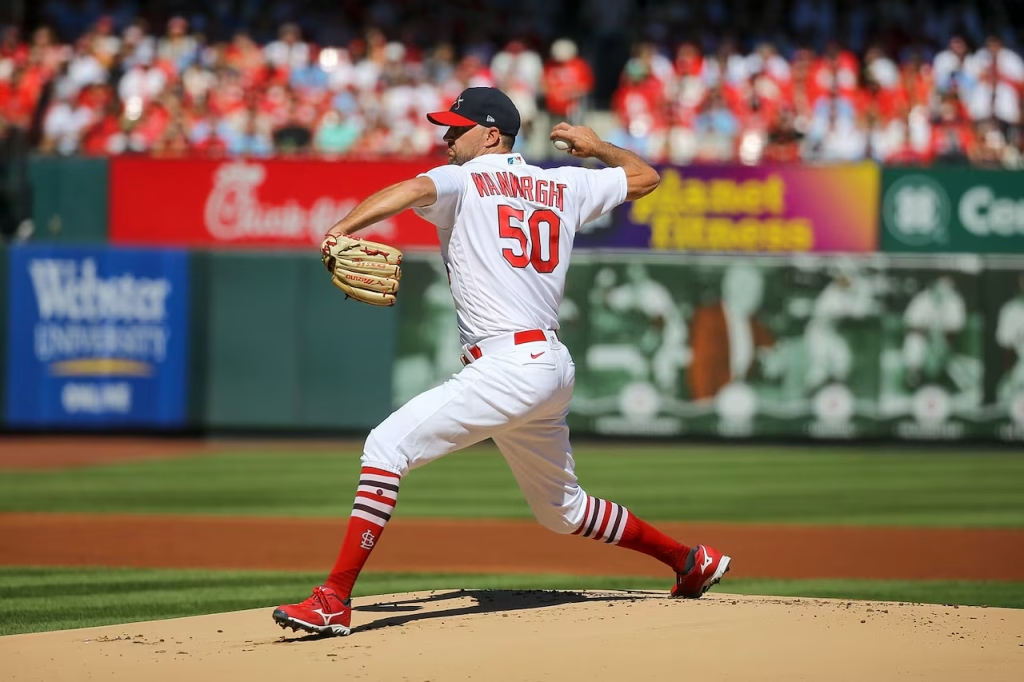
One of the best examples of this pitching philosophy comes from a pitcher who never called Coors Field home: Adam Wainwright.
During his long career with the St. Louis Cardinals, Wainwright built his success around a sinker, cutter, and curveball arsenal.
Velocity was never his defining trait.
Instead, he controlled the quality of contact.
Statcast pitch data shows that Wainwright frequently distributed his arsenal across multiple pitches. The sinker, curveball, cutter, four-seam fastball
The sinker generated ground balls.
The cutter induced weak contact.
The curveball disrupted timing.
This is exactly the type of arsenal that translates well to altitude.
Sinkers rely less on vertical ride and more on downward movement. Cutters maintain lateral movement even when the Magnus effect weakens. Curveballs remain effective as timing pitches even if they lose some bite.
Wainwright’s career demonstrates a key insight often discussed in analytical publications like Baseball Forecaster.
The best pitchers do not always dominate hitters.
They control how hitters make contact.
At Coors Field, that skill becomes essential.
The Rise of Pitch Design and Movement Analytics
In the modern era, pitching strategy has become inseparable from pitch design.
Pitching labs across baseball now analyze:
- Spin rate
- Spin axis
- Pitch tunneling
- Vertical approach angle
- Release point consistency
Pitchers increasingly modify their arsenals based on movement data.
Some of the most successful examples include:
Corbin Burnes
Burnes reinvented himself by transforming his pitch mix. He abandoned a traditional four-seam fastball in favor of a cutter-based arsenal that generated weak contact.
Logan Gilbert
Gilbert uses pitch movement profiles and tunneling to maximize the deception of his arsenal, pairing a riding fastball with carefully shaped breaking balls.
Across baseball, pitchers are constantly adjusting pitch shapes based on analytical feedback.
For the Rockies, this technology creates a major opportunity.
Instead of designing pitches optimized for sea-level parks, Colorado could design arsenals specifically for altitude.
The Albuquerque Laboratory

The Rockies possess a unique developmental asset.
Their Triple-A affiliate, the Albuquerque Isotopes, plays at nearly the same elevation as Denver.
Isotopes Park sits at roughly 5,300 feet above sea level, meaning the altitude physics closely mirror Coors Field.
Rather than treating Albuquerque as a hitter’s nightmare, the Rockies could turn it into an altitude pitching laboratory.
Prospects could use pitch-tracking data to study exactly how their pitches behave in thin air.
A slider that breaks eight inches at sea level might break only six inches in Albuquerque.
Knowing that early allows pitchers to redesign their arsenals.
They can experiment with: sinker grips, cutter shapes, slider and spin axis adjustments.
Instead of discovering altitude effects in the major leagues, pitchers would arrive already adapted.
Building the Coors Field Pitcher
If the Rockies embraced an altitude-focused pitching philosophy, the ideal pitcher profile would become clear.
The successful Coors Field pitcher likely needs:
- Ground-ball rate above 50 percent
- Command on the edges of the strike zone
- Sinker or cutter as a primary pitch
- Limited reliance on four-seam fastball ride
This archetype is the contact manager.
Instead of maximizing strikeouts, the pitcher manages batted-ball outcomes.
Ground balls become outs.
Fly balls are minimized.
Damage is controlled.
Rockies Prospects Who Could Fit the Model

Several current Rockies pitching prospects could adapt well to this philosophy.
Gabriel Hughes
Hughes features a fastball with strong downward plane and a slider capable of generating ground balls. A sinker-heavy approach could make him a natural Coors Field starter.
Chase Dollander
Dollander’s college dominance came from a high-spin four-seam fastball. That pitch may lose some effectiveness at altitude.
However, if he incorporates more two-seam fastballs and cutters, he could transition into a strong contact-management starter.
Jackson Cox
Cox may be particularly interesting if his cutter becomes the centerpiece of his arsenal. Cutter-based arsenals tend to hold up well in thin air.
With proper development, pitchers like these could form the foundation of a rotation designed specifically for Coors Field.
The Future of Pitching in Denver
For thirty years the Rockies have fought against their environment.
But the modern era of pitch design and data analysis offers a new path forward.
Altitude cannot be changed.
Physics cannot be ignored.
But pitching strategy can evolve.
By embracing contact management, designing pitches specifically for altitude, and developing pitchers within the Albuquerque environment, the Rockies could finally build a sustainable pitching model.
The key insight is simple.
The pitchers most likely to succeed at Coors Field are not the ones who overpower hitters.
They are the ones who control contact.
And that blueprint may finally provide the answer to one of baseball’s longest-standing problems.
More Prospect Analysis Here:

Roch Cholowsky: The Most Complete College Bat in the 2026 Draft
Every draft cycle produces a few players whose statistical record and scouting profile align so…

Thomas White Is Winning the Battle Before the Ball Leaves His Hand
There are pitching prospects who are succeeding because minor league hitters cannot catch up to…

JJ Wetherholt Is Starting to Look Like a “Not If, But When” Call-Up
There’s a certain type of prospect season where the conversation quietly shifts from “is he…